Self Employed Lending Strategies
A guide that breaks down the main strategies and how your tax strategy will impact your lending options



Introduction
Being self-employed gives you flexibility and freedom but borrowing can sometimes feel more complicated.
Lenders often want to see detailed proof of income, which doesn’t always reflect the real strength of your business.
The good news? There are multiple lending pathways available, designed to suit different types of self-employed clients.
This guide breaks down the main strategies and when each might work best.
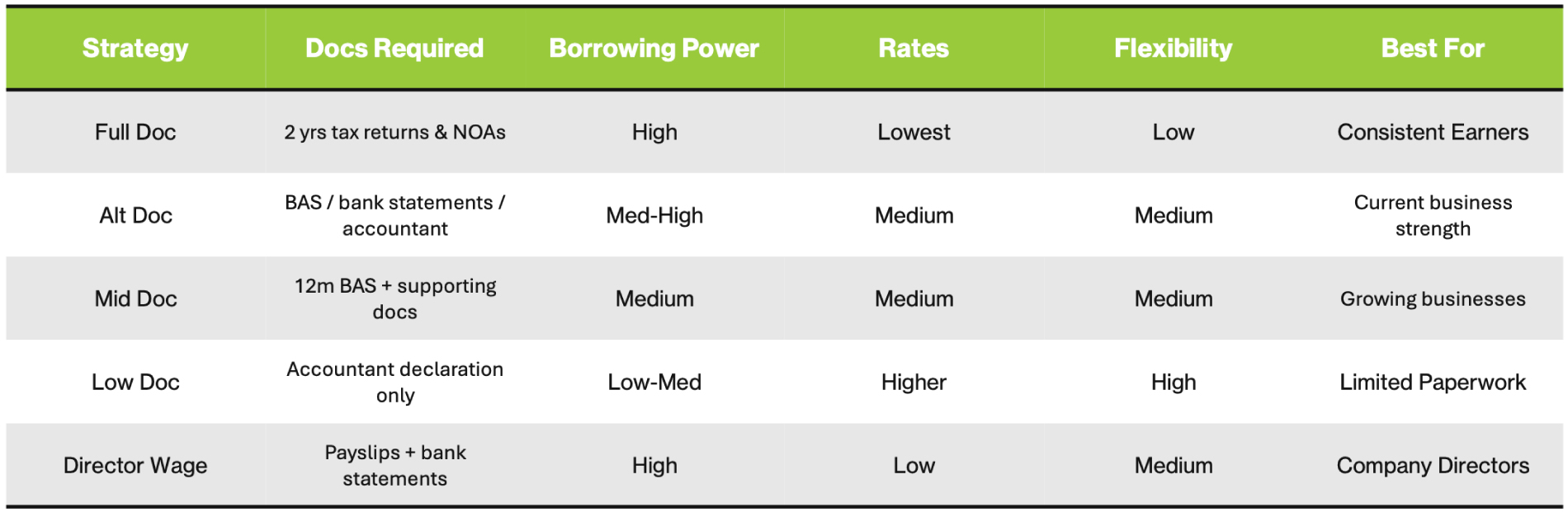
Strategy Comparison

Traditional Full-Doc
(Long Form)
What it is: The most common pathway.
Requirements: 1 to 2 years of personal and business tax returns, financials, and Notices of Assessment and 4 quarters BAS
Best for: Borrowers with consistent income and strong financials.
Benefits: Access to the widest range of lenders, sharpest rates, and maximum borrowing power.
Challenges: Can be restrictive if income is minimised for tax or fluctuates year-to-year.

Alt Doc
(Alternative Documentation)
What it is: A flexible approach using other income evidence.
Requirements: 6–12 months of business bank statements, BAS statements, or an accountant’s declaration.
Best for: Borrowers whose current trading performance is stronger than what past tax returns show.
Benefits: Recognises today’s business strength, not just historical lodged returns.
Challenges: Rates and fees may be higher than full-doc loans.

Mid Doc
What it is: A “middle ground” option.
Requirements: Often 12 months’ BAS or a mix of bank statements + accountant’s letters.
Best for: Businesses in a growth phase that hasn’t yet shown up in tax returns.
Benefits: More flexible than full-doc but still offers solid borrowing capacity.
Challenges: More scrutiny than low doc, with moderate rates.

Low Doc
What it is: Minimal paperwork lending.
Requirements: Usually just an accountant’s declaration of income.
Best for: Self-employed clients who haven’t lodged recent returns or have limited paperwork.
Benefits: Quick approvals, very light documentation.
Challenges: Higher rates, lower maximum borrowing amounts, and fewer lender options.

Director Wage Policy
(PAYG Strategy)
What it is: Structuring your income like a salaried employee.
Requirements: Payslips showing director’s wage + matching bank credits.
Best for: Company directors who can pay themselves regular PAYG income.
Benefits: Treated as a standard PAYG applicant — often unlocking sharper rates and wider lender choice.
Challenges: May reduce flexibility in how profits are distributed from the business.

Short Term Self Employed
(PAYG Strategy)
What it is: Where an applicant has recently gone self-employed from PAYG in the same role/industry. Liberty look at this.
Requirements: Income level for servicing and would seek either the last payment summary, or 2 payslips from that role.
Best for: People who have recently moved from PAYG to Self Employed in the same role/industry.
Benefits: Treated as a standard PAYG applicant and income without the need for ABN minimum length or using the income of the self employed trading which no other lender will do.
Challenges: Only one lender option and higher rates than the other options mentioned in most of the other avenues.

Key Takeaways
Self-employed borrowers now have more lending options than ever.
The right pathway depends on:
• How much documentation you can provide
• The stage your business is at (startup, growth, mature)
• Whether you value lower rates or faster approval more

Lets’ Find The Right Pathway For You
At JT Home Loans, we specialise in lending strategies for self-employed clients. We’ll work with you to structure your application in the way that best showcases your business.
Josh Trevitt
m. 0420 315 795
e. joshua@jthomeloans.com.au
















CONTACT
Joshua Trevitt
Ronda Trevitt
Admin Team
ADDRESS
JT Home Loans
20/107 Wells Road
Chelsea Heights VIC 3197
PO Box 12040
Carrum VIC 3197
FOLLOW US

PLATINUM AWARDS